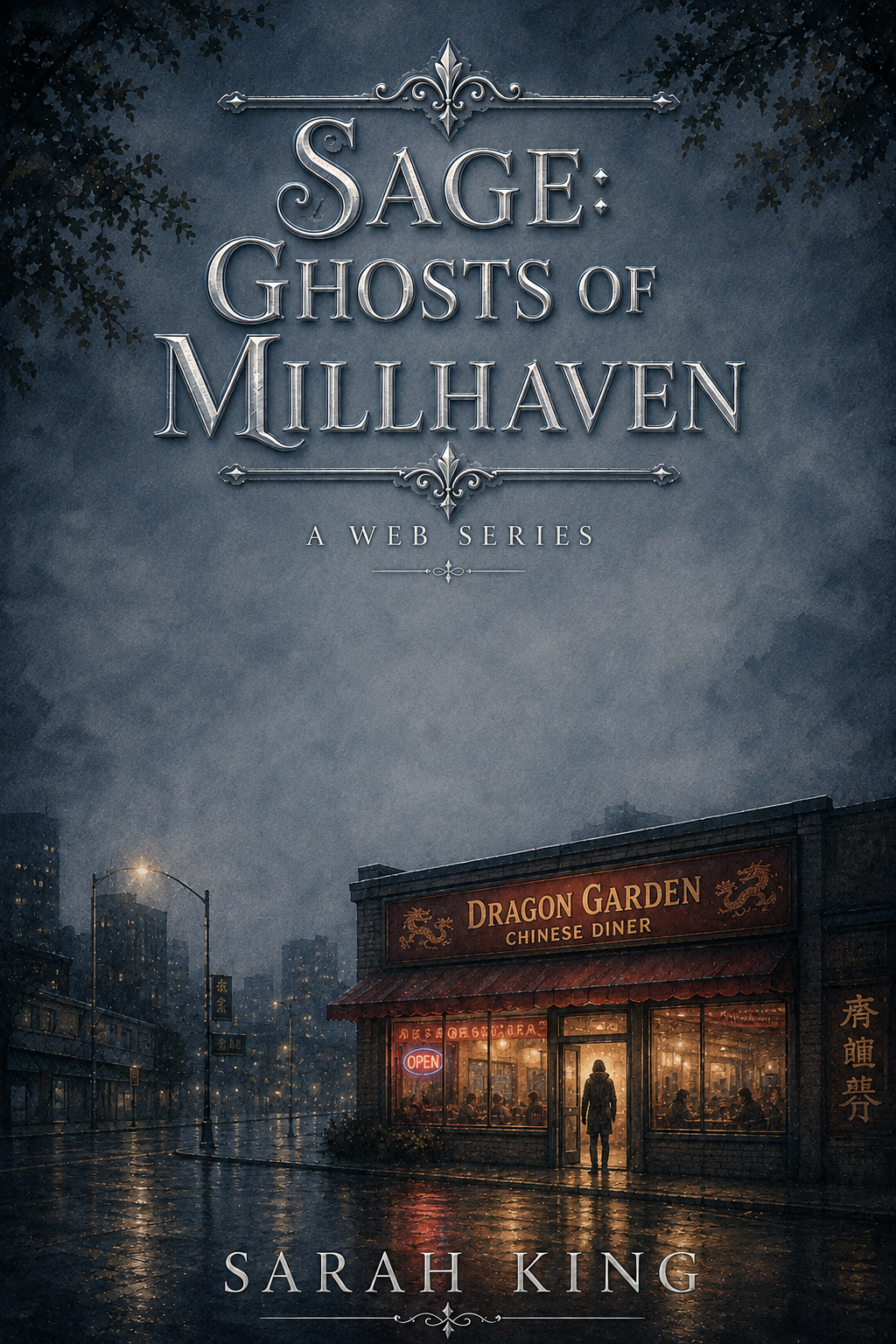
Episode Nine
Enough Enduring
The tip sheet was three pages long and most of it was garbage. Nate had learned that much in his first couple of weeks at the precinct. Informants padded their information the way a kid padded a book report, stretching two real sentences into ten to make it look like more than it was.
"Page two," Eli said, dropping a coffee on Nate's desk without being asked. "Third paragraph. Read it out loud, it's better that way."
"I can read it silently just fine."
"Sure, but I want to watch your face."
Nate found the paragraph. It was a supply list, half-legible, the kind of thing a low-level runner scrawled on the back of a receipt and then panicked about and tried to burn, except he'd only burned one corner before somebody found him with it. Names, half-names, a few numbers that might have been weights or might have been prices. Buried in the middle, underlined twice by whoever had transcribed it, was a single line.
**V. Marsh, Kesting Row (Jade Palace) - supply, unconfirmed.**
"Jade Palace," Nate said. "That the diner?"
"That's the diner. Best dumplings in Kesting Row, not that it's a long list. My cousin used to work two doors down, said the owner's some big personality type, wears a suit to run a diner, like he's auditioning for something." Eli perched on the edge of Nate's desk, which he did whenever he wanted to talk without making it look like he was settling in for a conversation. "Word is his name's come up before. Never sticks. Guy's slippery, or he's clean, or somebody upstream keeps making sure it looks that way."
"Which do you think it is?"
"I think a place doesn't get whispered about for five years running because somebody likes the almond chicken." Eli shrugged. "But that's a guess dressed up as an opinion, so don't quote me at the captain."
Captain Beaumont came by not two minutes later, as if summoned by the mention of his own name, and looked at the sheet over Nate's shoulder without asking permission. He had a way of reading a page that made you feel like it was already old news to him, even the first time.
"Unconfirmed," Beaumont said, tapping the line with one blunt finger. "Keep it that way until it isn't. I don't want Marsh's name in a report unless there's something underneath it besides a runner's handwriting."
"Copy that," Nate said.
"You've been on this floor a week and a half, Bishop. Hear this once. Half that district runs on rumour because rumour's cheaper than proof and does almost as much damage. You want to be careful which parts you let yourself believe before you've earned the right to." Beaumont straightened, already looking at something else across the bullpen, already halfway to his next problem. "Flag it. Don't chase it. Not yet."
He walked off. Eli waited until he was out of earshot before he leaned in.
"Translation: he thinks there's something there too, but he's not going to say so until it costs him less to be wrong."
"You get all that from four sentences?"
"I've worked for the man two years. I could write you a dictionary."
Nate looked back at the sheet, at the underlined name, at the word Kesting Row sitting there in ordinary block letters like it hadn't done anything to earn a second look. It hadn't. It was a district name, that was all, a patch of the city where he'd spent the last week knocking on doors about a string of break-ins. But something about the words on the page snagged at him anyway, low and persistent, like a splinter under a callus, there but not quite locatable.
He rubbed at his sternum without meaning to and caught Eli watching him do it.
"You good?"
"Fine," Nate said, and filed the sheet, and did not think about it again for almost four hours, which for him currently counted as a personal best.
* * *
Sage noticed the note before her shift even started, which should have been her first warning that the day wasn't going to behave itself.
It was tucked into the strap of her bag, folded down to the size of a matchbook, the kind of fold that took intention. She almost didn't see it. She almost threw the whole bag over her shoulder and walked the six blocks to Jade Palace without ever knowing it was there, and some small, tired part of her wished afterward that she had.
She unfolded it standing at the corner of Delray and Ninth, waiting for a light that took its time.
*Your aunt asked the same question you're starting to ask. She didn't stop soon enough. Neither did your parents. This isn't a threat. It's the truth, and you deserve at least that much before you decide what to do with it.*
No signature. There was never a signature. This was the third one in four months, and each time she told herself the same thing, that it was a prank, that somebody from school had figured out enough about her past to make a cruel joke of it, that there was a rational, boring explanation sitting just out of reach if she looked hard enough. Each time the explanation refused to arrive.
The light changed. She crossed anyway, note folded back down small and shoved into her coat pocket where her fingers could find the edge of it through the fabric, a nervous habit she hadn't noticed she'd developed until just now.
Olivia caught her at lunch, three hours later, looking like she hadn't slept enough, which was accurate.
"You look like you got hit by a bus," Olivia said, sliding her tray down across from Sage's untouched one. "A small bus. Like a shuttle."
"Thanks."
"I'm allowed to say it, I'm your friend." Olivia unwrapped her sandwich with the calm efficiency of someone who had never once had to wonder where her next meal was coming from, which Sage had stopped resenting somewhere around month three of knowing her, mostly. "You want to talk about it?"
"Talk about what?"
"Whatever's making you look like that."
Sage almost told her. That was the strange thing about Olivia, the low simmering pull of her, the way she made honesty feel like it might be survivable. Sage had felt it before, that same loosening, right before she'd caught herself and backed away from it weeks ago, and she felt it again now, and again she let the moment pass without taking it.
"Just tired," Sage said. "Didn't sleep great."
Olivia looked at her for a second too long, the way she did sometimes, like she was reading something written in smaller print than the rest of the page. Then she let it go, because that was the other strange thing about Olivia, she knew how to want an answer and not demand one at the same time.
"Okay," she said. "But if the bus comes back, you tell me."
"Deal."
By the time Sage got to Jade Palace after school the note had gone soft and worn at its folds from being touched too many times through her pocket. She hung her coat on the peg in the back and tied her apron and told herself, again, that she would think about it later, when she had the energy to think about it properly, which was the same thing she'd told herself about the first two notes and had never actually done.
Marsh was behind the counter when she came out front, sleeves rolled with the kind of precision that made even rolled sleeves look like a costume choice, counting the till with theatrical concentration.
"There she is," he said, not looking up. "You're pale, kid. You eating?"
"I eat."
"You eat diner food twice a week and whatever you can afford the other five days, which I choose not to think too hard about, because it upsets me." He snapped the cash drawer shut and finally looked at her properly, and for one uncomfortable second she felt like he was doing the same thing Olivia did, reading past the surface of her face to something underneath. Marsh was good at that. It was one of the things that made him dangerous in a way most people in Kesting Row never clocked until it was too late to matter, the fact that underneath all the flair and the tailored vests and the performance of it, he actually paid attention.
"I'm fine," she said, which was becoming her most-used sentence lately and felt less true every time she used it.
"Sure you are." He didn't push. He never pushed, not with her, and she'd stopped trying to figure out exactly why a man who ran what he ran had decided somewhere along the way that she was the one person in his orbit who didn't need to be managed or used, only looked out for. It didn't make sense with anything else she knew about him. It also didn't stop being true. "Table four needs their check. Try not to fall asleep between here and there."
She worked the rest of the shift on autopilot, refilling coffee, running plates, making change, and underneath all of it the note sat in her coat pocket in the back like a stone she'd swallowed and couldn't feel moving through her.
It was almost nine when it hit her.
She was carrying a bin of dirty dishes toward the kitchen, nothing dramatic, nothing that should have mattered, and the floor tilted sideways under her without actually moving, and the bin nearly went with it. She caught the edge of the counter with one hand and the world went somewhere else entirely.
A kitchen, bright and ordinary, and in the corner of it a pantry doorframe with pencil marks climbing it in careful increments, a child's height charted over what must have been years, never painted over, never erased. Down a short hallway, a small room, dim, a star-shaped nightlight glowing weak amber in one corner, throwing soft points of light across a ceiling Sage had never seen and somehow already knew.
Then noise, wrong and sudden, and grief arriving before the image that should have explained it, grief so total it had no edges, and somewhere in the middle of that grief a name, not spoken so much as felt, two syllables that meant everything and nothing to her at once.
*Kimberly.*
It lasted four seconds. Maybe five. When it let go of her she was on one knee beside the overturned dish bin, plates cracked across the floor tile, and Marsh was already crouched in front of her with a hand not quite touching her shoulder, hovering there like he wasn't sure if touching her would help or make it worse.
"Hey. Hey, look at me. You with me?"
"I'm okay," she managed, which was a lie so obvious even she didn't believe it coming out of her own mouth.
"You are not okay, you went white as the tablecloth and then you went down." His voice had lost every trace of theatre. This was the version of him almost nobody got to see, the one underneath the vest and the flourish. "You want the hospital?"
"No. No, I just, I skipped lunch, I think it's just." She grabbed the edge of the counter and pulled herself up before he could argue, her legs unsteady under her but holding. "Low blood sugar. I get like this sometimes."
He studied her for a long moment, and she could see him deciding whether to believe it, could see him choosing, deliberately, to let it go, the same way he always chose to let things go where she was concerned.
"Sit in the back for ten minutes," he said. "That's not a request."
She sat. She put her head down on her folded arms at the little table in the back room where the staff ate their breaks, and she let the shaking work its way out of her hands slowly, and she thought about the kitchen with the pencil marks and the star nightlight and the name that wasn't hers and didn't belong to anyone she knew, and underneath all of that she thought, with a clarity that frightened her more than the vision had, *this is the first time it has given me a name.*
The other times had only been pictures, a porch swing, a doorframe, a nightlight, never a word attached to any of them. She'd told herself it was nothing. Stress. A weird dream bleeding into her waking hours. She had a long list of explanations for things lately, and every single one of them was starting to feel like something she'd built on purpose, brick by brick, specifically so she wouldn't have to look at what was underneath.
* * *
Her apartment in Kesting Row was small enough that she could cross it in a dozen steps, and most nights that was fine, that was even a kind of comfort, a space entirely hers that nobody else had a claim on. Tonight it felt too small to hold what she'd brought home in her chest.
She sat on the edge of her bed with the note from that morning smoothed flat on her knee, and beside it she put the other two, retrieved from the shoebox at the back of her closet where she kept the handful of things she hadn't been able to throw away and hadn't been able to look at either. Three notes now, three pieces of paper in three different handwritings that might have all been the same hand disguised, or might not have been, she genuinely couldn't tell, and each one saying some version of the same thing in different words.
*Your aunt asked questions. Your parents asked questions. It cost them everything.*
She had spent two years telling herself she didn't want to know more than that. It had felt, for a long time, like the safer choice, maybe the only choice a person in her position actually had. She was fifteen, alone, working under the table at a diner that hid something ugly behind its kitchen door, keeping her head down at school, keeping one friend at careful arm's length specifically so nothing could get close enough to hurt either of them. Not knowing had felt like armour. If she didn't ask, nothing could answer her with something worse than the silence she already had.
But the silence had never actually been silent. It had a kitchen in it now, and a pantry doorframe with pencil marks on it, and a name that wasn't hers landing in her chest like it belonged there. It had been reaching into her for longer than she wanted to admit, longer than these three folded notes, longer maybe than she had any real memory of, and she had spent all of it enduring, absorbing, waiting for it to stop on its own the way a fever breaks if you just get enough sleep and drink enough water and refuse to look at the thermometer.
It wasn't going to stop on its own. She understood that now with a plainness that felt almost like relief, the way it's sometimes a relief to finally admit a thing you've known for a long time without letting yourself know it.
She got up and pulled the shoebox all the way out from the closet, sat back down with it in her lap, and went through it properly for the first time in longer than she wanted to count. Her aunt's things, what little of them she'd kept. A library card with an expiry date years past. A photograph, corners soft with handling, of a woman with Sage's same stubborn chin, laughing at something outside the frame. A folded newspaper clipping, brittle now, that Sage had never actually finished reading because reading it all the way through had felt, at thirteen, like something she wasn't ready to survive.
She unfolded it now. Read it slowly, all the way to the bottom this time. It didn't tell her much. It was a short piece, local, mentioning her aunt's name only in passing, circumstances of death listed as unclear, investigation listed as ongoing, a phrase that had apparently stopped meaning anything to anyone a long time ago, because nothing had ever come of it.
Sage folded it back along its old creases, careful with it, and set it down on top of the three notes.
Something had killed her aunt. Something had taken her parents before that, in some way she'd never been told and had never let herself ask about, because asking felt like inviting the same fate to come find her too. Something was reaching into her now, on its own schedule, showing her rooms she'd never stood in and grief that wasn't hers to carry, and leaving her folded warnings in handwriting she didn't recognize, and she had spent two solid years treating all of it like weather. Something that happened to her. Something to get through.
She thought of Marsh's hand hovering over her shoulder in the back room, not quite touching, careful in a way that had nothing to do with kindness alone and everything to do with a man who suspected more than he said and had decided, for reasons of his own, not to press.
She thought of Olivia at lunch, patient, waiting for an answer Sage hadn't been ready to give, and the way that patience had felt like an invitation Sage kept declining out of habit rather than actual choice.
She thought of the pull itself, twice now, strong enough to put her on the floor, carrying somebody else's grief into her body like it had every right to be there.
She was tired of being the person things happened to.
It wasn't a large decision, not the kind that changed the shape of a room when you made it. Nobody would have been able to look at her and see anything different. But something in her had shifted anyway, quiet and definite, the way a key turns in a lock without any drama at all and yet the door that was closed a second ago is not closed anymore.
She lifted the loose floorboard and took out the spiral notebook she'd kept since the collision, the one that had only ever held dates and times and a column she called intensity, and she turned to a clean page and wrote the date at the top. Then, underneath it, she wrote down everything she could remember. The first pull, as much of it as she'd managed to hold onto. Tonight's, in full, the kitchen and the pencil marks and the nightlight and the name that wasn't hers. The three notes, copied out word for word, because paper this old and this worn wasn't going to last forever and she needed the words to survive longer than the pages did. The newspaper clipping, summarized. Everything she knew about her aunt's last months, which wasn't much, but was more than nothing, and nothing was what she'd been working with for two years.
She didn't know yet where any of it led. She didn't know who had written the notes, or why the pull had chosen tonight to come back stronger than before, or whose hallway that had been, whose grief, whose child's height climbing a doorframe in pencil. She didn't know if finding out would be survivable, given what it hadn't been for the people who'd asked these questions before her.
But she was going to find out. She wrote that down too, plain as anything else on the page, because it felt important to have it in her own handwriting where she could look at it later and know she'd meant it.
*I'm done waiting for this to stop happening to me. I'm going to find out what it is.*
Outside, Kesting Row went on being itself, indifferent and unhurried, streetlights buzzing faintly over cracked sidewalks, somewhere a dog barking at nothing. Sage closed the notebook, but she didn't put it away. She left it out on the small table by her bed, where she'd see it first thing in the morning, so that whatever came next, she wouldn't be able to pretend she hadn't chosen it.